 Add to Chrome
 Add to Firefox
 Add to Edge
FedSmoothLoRA: Toward Smoother and Faster Convergence in Federated Low-Rank Adaptation
May 28, 2026
Federated fine-tuning of foundation models with Low-Rank Adaptation (LoRA) provides an efficient solution for reducing communication and computation costs while preserving data locality. However, the direct combination of FedAvg and LoRA suffers from three key issues: limited update space, which restricts the model's effective learning capacity; inter-round state mismatch, which disrupts cross-round local optimization continuity; and a client-agnostic starting state, which slows local convergence on clients. Although recent methods mitigate the limited update space issue by merging LoRA updates into the backbone across communication rounds, inter-round state mismatch and the client-agnostic starting state remain insufficiently addressed. To address these issues, we propose FedSmoothLoRA, a federated LoRA tuning framework that preserves the enlarged update space, improves cross-round local optimization continuity, and provides a client-aware starting state for local training. At each communication round, FedSmoothLoRA constructs the local LoRA initialization using two matrices: a Round-Matching matrix that preserves cross-round local state continuity, and a Gradient-Aligned matrix that provides client-specific optimization guidance from gradient signals estimated on local data. Together, these designs enable smoother and faster convergence. Extensive experiments on image classification and natural language generation tasks demonstrate that FedSmoothLoRA consistently outperforms existing federated LoRA tuning methods. Code: https://github.com/wangzehao0704/FedSmoothLoRA

AnE: Pushing the Reasoning Frontier of Multimodal LLMs via Anchor Evolution
May 25, 2026Post-training via Supervised Fine-Tuning (SFT) and Reinforcement Learning (RL) is crucial for enhancing reasoning in Multimodal Large Language Models (MLLMs), yet existing paradigms often reach a performance bottleneck due to the limitations of static data. While current methods leverage self-reflection or self-evolution to push these boundaries, they still suffer from cognitive drift and hallucinated reasoning paths caused by low-quality synthetic data. To address these challenges, we propose Anchor Evolution (AnE), a new paradigm that integrates truth-anchored data curation and model evolution, achieving faithful and steady performance gains at the reasoning frontier. Specifically, we propose Truth Anchor Expansion, which pinpoints the model failing frontier via trajectory rollouts and leverages ground-truth databases to retrieve high-fidelity anchors for faithful data curation. Subsequently, we introduce the Scaffold-Stripping Mechanism to internalize reasoning capabilities. This mechanism first anchors reasoning paths via scaffold-augmented supervision to mitigate the learning complexity and distribution drift of direct SFT on raw data, then leverages RL to strip the scaffold template, thereby effectively transitioning the reasoning paths into intrinsic model capabilities. Experimental results on multimodal reasoning benchmarks show that our method substantially advances the model performance frontier, improving the base model by 10.3\% across eight multimodal benchmarks and achieving state-of-the-art results. The code will be made publicly available.
OPERA: An Agent for Image Restoration with End-to-End Joint Planning-Execution Optimization
May 21, 2026Real-world image restoration is challenging due to complex and interacting mixed degradations. Recent agent-based approaches address this problem by composing multiple task-specific restoration tools. However, empirical analysis reveals that their performance is fundamentally limited by implicitly constrained planning spaces and the lack of coordination among independently pretrained tools. To address these issues, we propose OPERA (Optimized Planning-Execution Restoration Agent), a framework that jointly optimizes restoration planning and tool execution in an end-to-end manner. On the planning side, OPERA uses reinforcement learning to directly optimize tool composition over a combinatorial plan space, with the final restoration quality as the reward. On the execution side, OPERA introduces agent-guided co-training of restoration tools, enabling them to learn cooperative behaviors under sequential composition. Extensive experiments on multi-degradation benchmarks and real-world datasets demonstrate that OPERA consistently outperforms both all-in-one restoration models and existing agent-based methods across diverse and complex degradation scenarios.
CGL: Advancing Continual GUI Learning via Reinforcement Fine-Tuning
Mar 03, 2026Graphical User Interface (GUI) Agents, benefiting from recent advances in multimodal large language models (MLLM), have achieved significant development. However, due to the frequent updates of GUI applications, adapting to new tasks without forgetting old tasks in GUI continual learning remains an open problem. In this work, we reveal that while Supervised Fine-Tuning (SFT) facilitates fast adaptation, it often triggers knowledge overwriting, whereas Reinforcement Learning (RL) demonstrates an inherent resilience that shields prior interaction logic from erasure. Based on this insight, we propose a \textbf{C}ontinual \textbf{G}UI \textbf{L}earning (CGL) framework that dynamically balances adaptation efficiency and skill retention by enhancing the synergy between SFT and RL. Specifically, we introduce an SFT proportion adjustment mechanism guided by policy entropy to dynamically control the weight allocation between the SFT and RL training phases. To resolve explicit gradient interference, we further develop a specialized gradient surgery strategy. By projecting exploratory SFT gradients onto GRPO-based anchor gradients, our method explicitly clips the components of SFT gradients that conflict with GRPO. On top of that, we establish an AndroidControl-CL benchmark, which divides GUI applications into distinct task groups to effectively simulate and evaluate the performance of continual GUI learning. Experimental results demonstrate the effectiveness of our proposed CGL framework across continual learning scenarios. The benchmark, code, and model will be made publicly available.
PhysWorld: From Real Videos to World Models of Deformable Objects via Physics-Aware Demonstration Synthesis
Oct 24, 2025Interactive world models that simulate object dynamics are crucial for robotics, VR, and AR. However, it remains a significant challenge to learn physics-consistent dynamics models from limited real-world video data, especially for deformable objects with spatially-varying physical properties. To overcome the challenge of data scarcity, we propose PhysWorld, a novel framework that utilizes a simulator to synthesize physically plausible and diverse demonstrations to learn efficient world models. Specifically, we first construct a physics-consistent digital twin within MPM simulator via constitutive model selection and global-to-local optimization of physical properties. Subsequently, we apply part-aware perturbations to the physical properties and generate various motion patterns for the digital twin, synthesizing extensive and diverse demonstrations. Finally, using these demonstrations, we train a lightweight GNN-based world model that is embedded with physical properties. The real video can be used to further refine the physical properties. PhysWorld achieves accurate and fast future predictions for various deformable objects, and also generalizes well to novel interactions. Experiments show that PhysWorld has competitive performance while enabling inference speeds 47 times faster than the recent state-of-the-art method, i.e., PhysTwin.
Tool-R1: Sample-Efficient Reinforcement Learning for Agentic Tool Use
Sep 16, 2025Large language models (LLMs) have demonstrated strong capabilities in language understanding and reasoning, yet they remain limited when tackling real-world tasks that require up-to-date knowledge, precise operations, or specialized tool use. To address this, we propose Tool-R1, a reinforcement learning framework that enables LLMs to perform general, compositional, and multi-step tool use by generating executable Python code. Tool-R1 supports integration of user-defined tools and standard libraries, with variable sharing across steps to construct coherent workflows. An outcome-based reward function, combining LLM-based answer judgment and code execution success, guides policy optimization. To improve training efficiency, we maintain a dynamic sample queue to cache and reuse high-quality trajectories, reducing the overhead of costly online sampling. Experiments on the GAIA benchmark show that Tool-R1 substantially improves both accuracy and robustness, achieving about 10\% gain over strong baselines, with larger improvements on complex multi-step tasks. These results highlight the potential of Tool-R1 for enabling reliable and efficient tool-augmented reasoning in real-world applications. Our code will be available at https://github.com/YBYBZhang/Tool-R1.
C2-Evo: Co-Evolving Multimodal Data and Model for Self-Improving Reasoning
Jul 22, 2025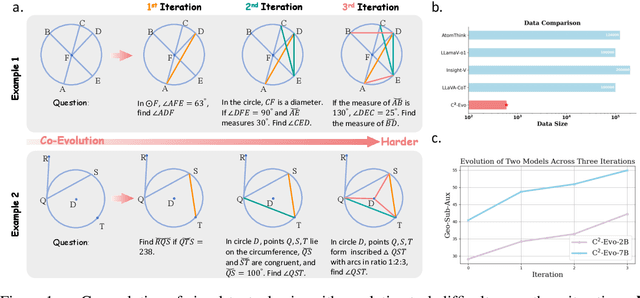
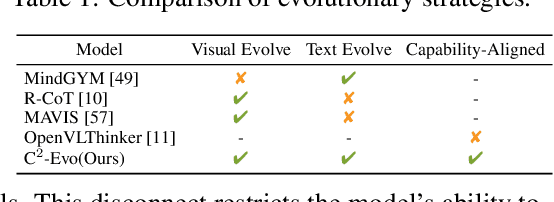
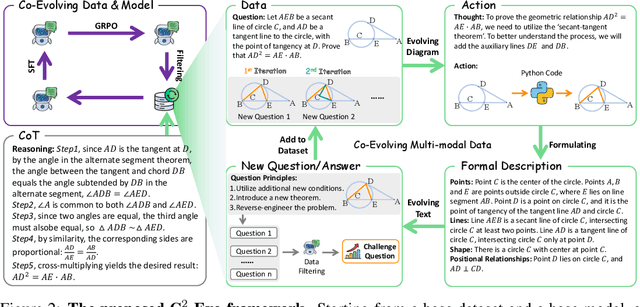
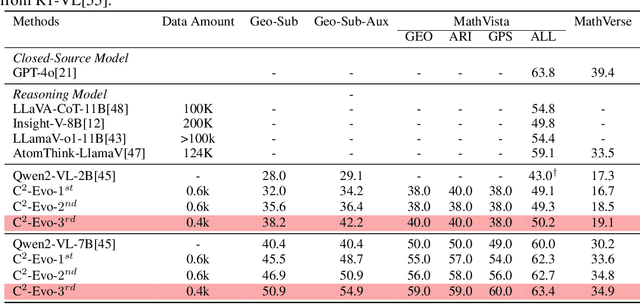
Recent advances in multimodal large language models (MLLMs) have shown impressive reasoning capabilities. However, further enhancing existing MLLMs necessitates high-quality vision-language datasets with carefully curated task complexities, which are both costly and challenging to scale. Although recent self-improving models that iteratively refine themselves offer a feasible solution, they still suffer from two core challenges: (i) most existing methods augment visual or textual data separately, resulting in discrepancies in data complexity (e.g., over-simplified diagrams paired with redundant textual descriptions); and (ii) the evolution of data and models is also separated, leading to scenarios where models are exposed to tasks with mismatched difficulty levels. To address these issues, we propose C2-Evo, an automatic, closed-loop self-improving framework that jointly evolves both training data and model capabilities. Specifically, given a base dataset and a base model, C2-Evo enhances them by a cross-modal data evolution loop and a data-model evolution loop. The former loop expands the base dataset by generating complex multimodal problems that combine structured textual sub-problems with iteratively specified geometric diagrams, while the latter loop adaptively selects the generated problems based on the performance of the base model, to conduct supervised fine-tuning and reinforcement learning alternately. Consequently, our method continuously refines its model and training data, and consistently obtains considerable performance gains across multiple mathematical reasoning benchmarks. Our code, models, and datasets will be released.
CoherenDream: Boosting Holistic Text Coherence in 3D Generation via Multimodal Large Language Models Feedback
Apr 28, 2025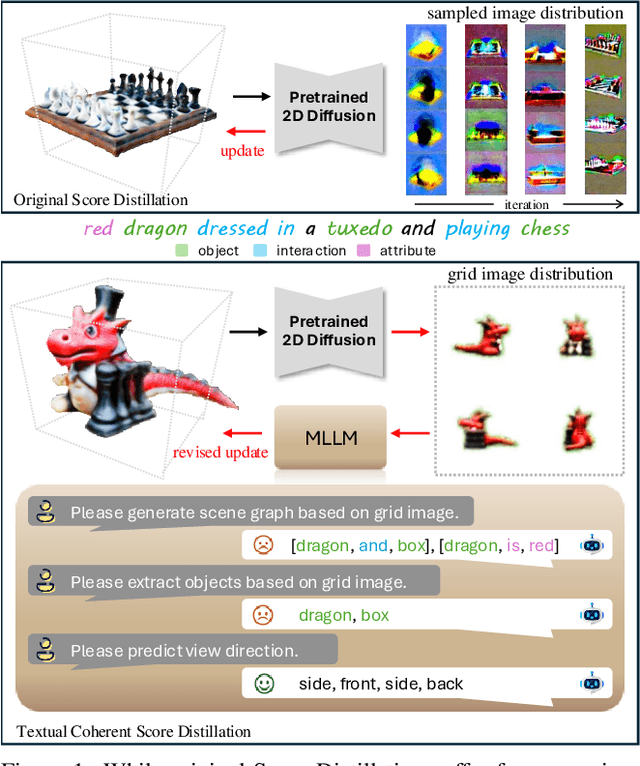
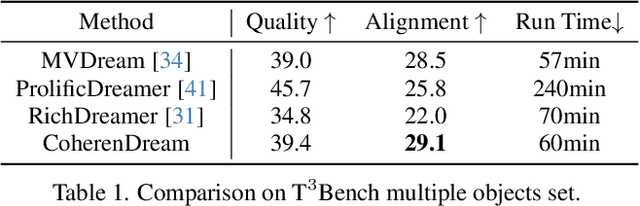
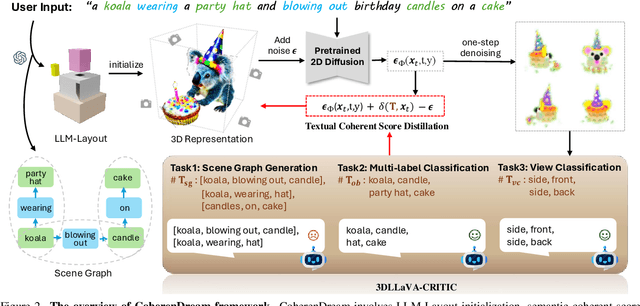
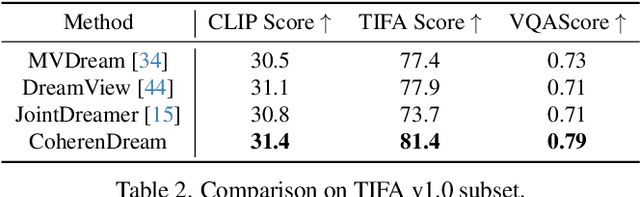
Score Distillation Sampling (SDS) has achieved remarkable success in text-to-3D content generation. However, SDS-based methods struggle to maintain semantic fidelity for user prompts, particularly when involving multiple objects with intricate interactions. While existing approaches often address 3D consistency through multiview diffusion model fine-tuning on 3D datasets, this strategy inadvertently exacerbates text-3D alignment degradation. The limitation stems from SDS's inherent accumulation of view-independent biases during optimization, which progressively diverges from the ideal text alignment direction. To alleviate this limitation, we propose a novel SDS objective, dubbed as Textual Coherent Score Distillation (TCSD), which integrates alignment feedback from multimodal large language models (MLLMs). Our TCSD leverages cross-modal understanding capabilities of MLLMs to assess and guide the text-3D correspondence during the optimization. We further develop 3DLLaVA-CRITIC - a fine-tuned MLLM specialized for evaluating multiview text alignment in 3D generations. Additionally, we introduce an LLM-layout initialization that significantly accelerates optimization convergence through semantic-aware spatial configuration. Comprehensive evaluations demonstrate that our framework, CoherenDream, establishes state-of-the-art performance in text-aligned 3D generation across multiple benchmarks, including T$^3$Bench and TIFA subset. Qualitative results showcase the superior performance of CoherenDream in preserving textual consistency and semantic interactions. As the first study to incorporate MLLMs into SDS optimization, we also conduct extensive ablation studies to explore optimal MLLM adaptations for 3D generation tasks.
Can Atomic Step Decomposition Enhance the Self-structured Reasoning of Multimodal Large Models?
Mar 08, 2025In this paper, we address the challenging task of multimodal mathematical reasoning by incorporating the ability of "slow thinking" into multimodal large language models (MLLMs). Our core idea is that different levels of reasoning abilities can be combined dynamically to tackle questions with different complexity. To this end, we propose a paradigm of Self-structured Chain of Thought (SCoT), which is composed of minimal semantic atomic steps. Different from existing methods that rely on structured templates or free-form paradigms, our method can not only generate cognitive CoT structures for various complex tasks but also mitigates the phenomenon of overthinking. To introduce structured reasoning capabilities into visual understanding models, we further design a novel AtomThink framework with four key modules, including (i) a data engine to generate high-quality multimodal reasoning paths; (ii) a supervised fine-tuning process with serialized inference data; (iii) a policy-guided multi-turn inference method; and (iv) an atomic capability metric to evaluate the single step utilization rate. We conduct extensive experiments to show that the proposed AtomThink significantly improves the performance of baseline MLLMs, achieving more than 10\% average accuracy gains on MathVista and MathVerse. Compared to state-of-the-art structured CoT approaches, our method not only achieves higher accuracy but also improves data utilization by 5 times and boosts inference efficiency by 85.3\%. Our code is now public available in https://github.com/Quinn777/AtomThink.
UniGS: Unified Language-Image-3D Pretraining with Gaussian Splatting
Feb 25, 2025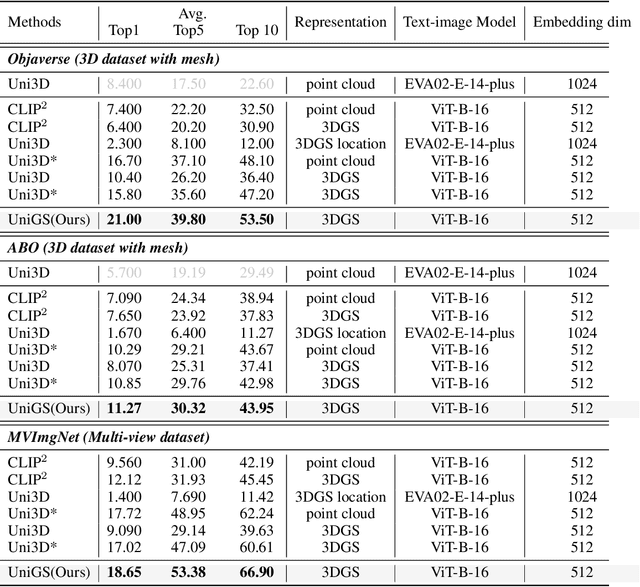
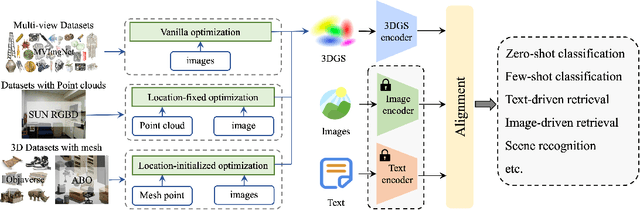
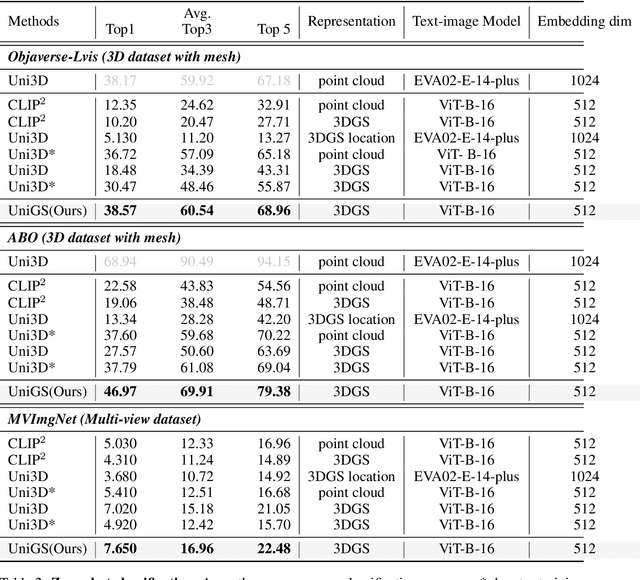
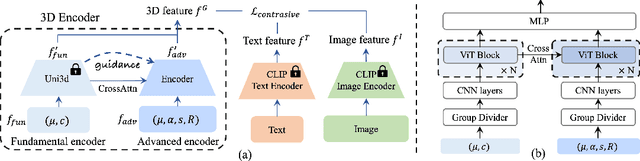
Recent advancements in multi-modal 3D pre-training methods have shown promising efficacy in learning joint representations of text, images, and point clouds. However, adopting point clouds as 3D representation fails to fully capture the intricacies of the 3D world and exhibits a noticeable gap between the discrete points and the dense 2D pixels of images. To tackle this issue, we propose UniGS, integrating 3D Gaussian Splatting (3DGS) into multi-modal pre-training to enhance the 3D representation. We first rely on the 3DGS representation to model the 3D world as a collection of 3D Gaussians with color and opacity, incorporating all the information of the 3D scene while establishing a strong connection with 2D images. Then, to achieve Language-Image-3D pertaining, UniGS starts with a pre-trained vision-language model to establish a shared visual and textual space through extensive real-world image-text pairs. Subsequently, UniGS employs a 3D encoder to align the optimized 3DGS with the Language-Image representations to learn unified multi-modal representations. To facilitate the extraction of global explicit 3D features by the 3D encoder and achieve better cross-modal alignment, we additionally introduce a novel Gaussian-Aware Guidance module that guides the learning of fine-grained representations of the 3D domain. Through extensive experiments across the Objaverse, ABO, MVImgNet and SUN RGBD datasets with zero-shot classification, text-driven retrieval and open-world understanding tasks, we demonstrate the effectiveness of UniGS in learning a more general and stronger aligned multi-modal representation. Specifically, UniGS achieves leading results across different 3D tasks with remarkable improvements over previous SOTA, Uni3D, including on zero-shot classification (+9.36%), text-driven retrieval (+4.3%) and open-world understanding (+7.92%).